
REVIEW: TWIN PEAKS: THE RETURN
I can't stop thinking about Twin Peak: The Return (or Season 3, depending how you want to look at it). Last night television changed. As the two-episode finale was aired and streamed, television changed and evolved into something we've never seen before and perhaps never will again. The last time television was this revolutionary, Neil Armstrong was on it saying "One small step for man, one giant leap for mankind!"

The first episode should've hinted that this is not the same quirky show that aired in 1990-1991, all about coffee, cherry pie, dancing dwarfs and the mystery of "Who Killed Laura Palmer?" There were traces of all of that, sure. There was plenty of humor scattered through-out, Dale Cooper's alter-ego Dougie Jones being a highlight, but this "Season 3" was a different beast. This season 3 was much darker and more surreal experience than what aired on ABC 26 years ago. At the time, Twin Peaks was as surreal as entertainment got, but that was a pre-Sopranos world where cable shows weren't common. Nowadays, with television being as strong as its ever been, thanks to less restrictions on cable compared to broadcast television and the rise of streaming services, I've wondered the past year what is Twin Peaks going to be like? Would it at all resemble the show 25 years ago, or with the limited regulations of cable, would Lynch simply run wild and created something in the vein of Lost Highway and Mulholland Dr.? Either way, Lynch was going to make something that made cable tv look conventional. But cable television is already unconventional and surprising every week. How can you shake up an industry that includes shows like Mad Men, Breaking Bad, Better Call Saul, Boardwalk Empire, True Detective, The Walking Dead and Games Of Thrones?
If you asked that last question, you don't know David Lynch. Lynch has always defied convention and pushed narrative storytellings into depths that have never been explored. His imagination is an enigma all by itself. How many artist can claim to have inspired an adjective? Had he not been Lynchian and more predictable and conventional, it would've been almost just as shocking as what we got.
So what was last The Return all about? Well…what the point explaining it? Either you've seen the original show and have been caught up with the new show as it aired, or you still haven't seen the show and are completely in the dark. Instead of reviewing the entire show episode by episode, (with Episode 8 being an art-form in an of itself) I'll simply say Episode 17 was as comprehensible as the show could've been. Our main character, Agent Cooper, was finally out of the black lodge, and raced back to Twin Peaks, the entire gang was there and Bob's story was more or less defeated. Yes, there were plenty of thing from the show still left unresolved, poor Audrey Horn's fate is pretty much up in the air, it certainly never explained the monster in the box in the first episode, but it came to resolution that more or less wrapped up all Twin Peaks fairly nice and what many probably expected. Then Episode 18 comes.
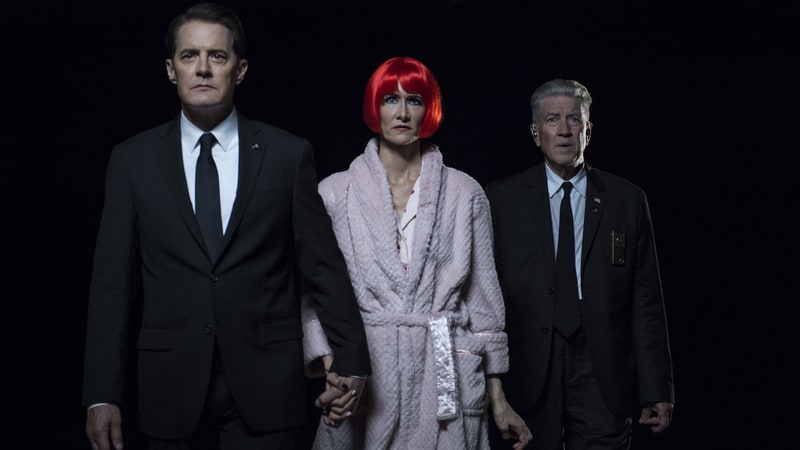
What starts as a romance with Cooper and Diane(the character long hinted through-out the show, finally revealed in this show as Laura Dern)then untangles a plot twist that feels almost straight out of Back To The Future Part II: the events from the original show is completely altered, to the point we're witnessing another dimension from the entire show people have experienced. By the end, it's not even sure we're watching Agent Cooper, but a completely different character entirely. "What year is this?" is a line that will be remembered through-out the eternity of television. It's the "Where's Annie?" of the new show.
A lot of people on social media were…angry to put it lightly. For some people, they were actually cursing out David Lynch personally for letting them be invested in the show through-out all these years(as if he is responsible for that) only to end on THAT note.
This could be the last we ever see of Twin Peaks: the rating were not as high as some were expecting(how could they?many fans of the original show could still be relying on broadcast television for entertainment and not get Showtime), whether we're getting another season, another movie on the likes of Fire Walk With Me, is completely speculative, and given how much everyone has aged perhaps unlikely. All I know is that Mark Frost's book The Final Dossier is expected to be a best-seller.
As far as many fans were concerned, what was the point of finally resolving the cliffhangers of Season 2, if the Season 3 some have waited 26 years for is going to leave THAT much unresolved.
But…mystery has ALWAYS been a big part of what makes Twin Peaks work. Seeing as Season 2 has been the "ending" of the show for a quarter of a century, it would feel, wrong, if everything concluded happy and conclusively like Blue Velvet did to an almost absurd extent. I really don't see this show could've ended any differently, certainly not in any way to make "everybody happy"(a goal that's impossible to accomplish and therefore not worth aiming for).
All I know is I was thrilled to the edge of my seat with the last episode, not sure what was going to happen, giving me, like most great movies but especially Lynch's, an "out-of-body" experience. This is art, unlike anything I've ever seen, perhaps ever will see.

People are trashing the ending of this show now, but remember, the movie Twin Peaks: Fire Walk With Me, was HATED by the public, certainly by those who only wanted Season 2 cliffhangers answered. Today, that movie is beloved, with many
calling it a masterpiece, and helps tie the original show with this "return". When they screened it at the Cannes Film Festival this year as part of the film's 25th anniversary(and as a promotion for this show) the audience cheered and gave Lynch a standing ovation! That's a far cry from when the film premiered at the same festival and the audience booed the film. Mulholland Dr. when it came out, confused many many people, leaving many people to complain that there is no point, there's no story, that it was just a tv pilot cobbled together and that its all meaningless. Today, virtually every film critic agrees that its the best movie released in the 21st century, and given the look of how the film industry is structured these days, it'll perhaps hold on to that title for the entire century, certainly in the foreseeable future. If there's anything to know about David Lynch, is that he ages like the finest of wines. His films are more significant and more important with each passing year.
So what do I REALLY think of Twin Peaks: The Return? Ask me in 25 years.
